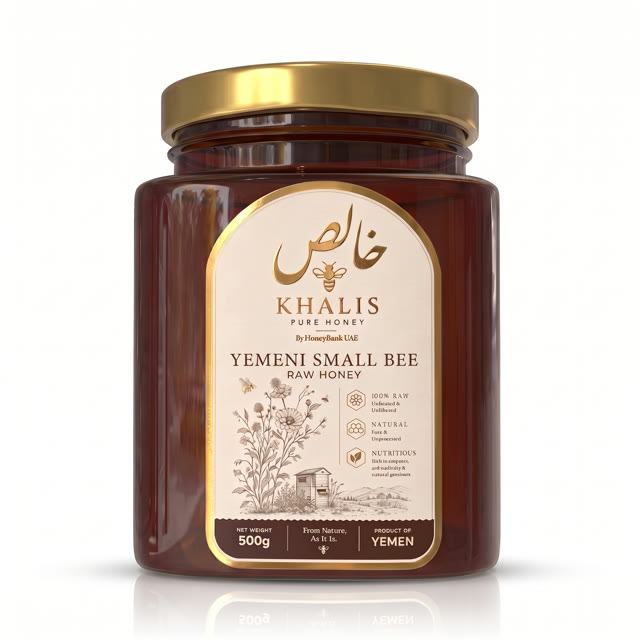
Khalis Yemeni Small Bee Honey
Choti makhi ka shehad — the tiny wild bee’s rare, intense harvest.
Bottled by HoneyBank — the Gulf's honey specialists, trusted by 20,000+ customers across the Emirates.
The story of this jar
The small wild bees of Yemen — choti makhi — build modest combs in cliffs and acacia scrub, and give honey in quantities that never get big. Gram for gram it is one of the scarcest honeys on earth.
The taste is concentrated: dark, tangy-sweet, faintly herbal, the kind of honey the old attar shops sold by the tola. Khalis brings it in genuinely limited quantities; when a batch is gone, it is gone until the bees decide otherwise.
From the source
Found, not farmed — tiny wild colonies in Yemen’s cliffs and acacia scrub.
- Single origin — one bloom, one landscape, never blended
- Harvested in season; batches are genuinely limited
- Sealed at source and imported whole — lab-checked by HoneyBank
Why this jar
Genuinely rare
Tiny wild colonies, tiny yields — this honey cannot be mass-produced, only found.
Traditional prestige
Small-bee honey is the connoisseur’s jar across Yemen and the Gulf.
Concentrated character
Intense, layered, medicinal-sweet — a little goes a long way.
How to take it
- Half a teaspoon, taken slowly — this is a tasting honey.
- Reserve it for yourself and honoured guests; it is not a cooking jar.
- Store tightly closed; its aroma is part of its value.
Pairs well with
Questions, answered
What is small bee (choti makhi) honey?
Honey gathered from Apis florea — the dwarf wild bee of Yemen and the Gulf. The colonies are small and wild, so yields are tiny and the honey is prized as a rarity.
Why does it cost Rs 5,250?
Scarcity. A single wild comb gives a fraction of what a farmed hive does, and it must be found, not farmed. You are paying for rarity that cannot be scaled.
How is it different from sidr?
Sidr is defined by the tree; small-bee honey is defined by the bee. It is tangier, more concentrated and more variable batch to batch — closer to a vintage than a product.