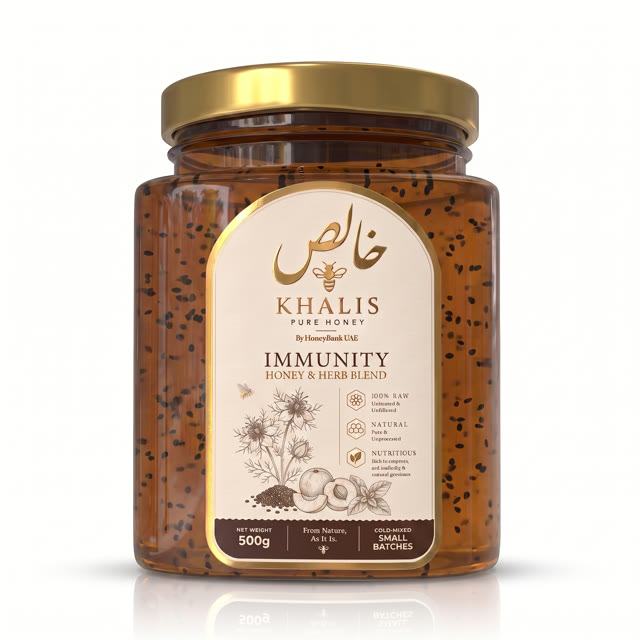
Khalis Immunity Honey
A full spoon of kalonji — the seed the hadith honoured — with amla, tulsi and propolis.
Bottled by HoneyBank — the Gulf's honey specialists, trusted by 20,000+ customers across the Emirates.
The story of this jar
Kalonji shehad is the most asked-for honey in Pakistan, and most jars sprinkle a pinch for the label. Immunity Honey is built the other way: a serious 1.5 g of cracked kalonji per spoon — a dose that means it — with dried amla, tulsi, sonth and propolis in raw honey.
Black seed’s place in our tradition needs no introduction. We simply treat it with respect: cracked fresh so the oils are alive, folded cold so the honey’s enzymes survive, weighed so every spoon carries the same measure.
The Khalis method
Built in the Khalis kitchen: raw honey as the base, tradition as the recipe.
- Whole herbs and spices, stone-ground in-house
- Folded cold into raw honey — never heated, never extracted
- Mixed in small weekly batches, dosed by weight
Why this jar
1.5 g kalonji per spoon
A weighed, honest dose of black seed — cracked, not powdered to dust, so the volatile oils stay.
Amla + tulsi + propolis
The subcontinent’s vitamin-C fruit, the household tonic herb, and the hive’s own defence resin.
The traditional daily spoon
One spoon every morning, all season — the way black seed has always been taken.
How to take it
- One teaspoon every morning, ideally on an empty stomach.
- Chew the kalonji specks — that’s where the seed’s character lives.
- Run the jar daily through winter; consistency is the whole tradition.
Pairs well with
Questions, answered
How much kalonji is actually in it?
About 1.5 grams of cracked black seed per teaspoon — a genuine traditional dose, not a sprinkle for the label. You will see and taste the seed.
Why kalonji with honey?
Black seed taken with honey is one of the oldest pairings in Muslim tradition. Honey carries the seed’s sharp taste and the two have been taken together for centuries across the subcontinent and the Gulf.
When should I take it?
Most customers take one spoon in the morning on an empty stomach, daily through the winter months.
Is this a medicine?
No. It is raw honey with traditional food ingredients. It makes no treatment claims — for medical conditions, talk to your doctor.